📗 Chapter 2: What is the UK?
2.1.3 UK terminology
3 paragraphs · 5 questions
There is often confusion about the terms 'United Kingdom', 'Great Britain', and 'British Isles' as they refer to different things. Great Britain refers to the island that includes England, Scotland, and Wales only. It does not include Northern Ireland. The United Kingdom includes Great Britain plus Northern Ireland.
Key Facts
- Great Britain = England + Scotland + Wales (not Northern Ireland)
- United Kingdom = Great Britain + Northern Ireland
- These terms are often confused but have distinct meanings
The British Isles is a geographical term that refers to the group of islands that includes Great Britain, Ireland, and many smaller islands such as the Isle of Wight, the Orkneys, and the Hebrides. This term can be controversial, particularly in the Republic of Ireland, as it implies a political connection that does not exist.
Key Facts
- British Isles is a geographical term for the island group
- Includes Great Britain, Ireland and smaller islands
- The term can be controversial in the Republic of Ireland
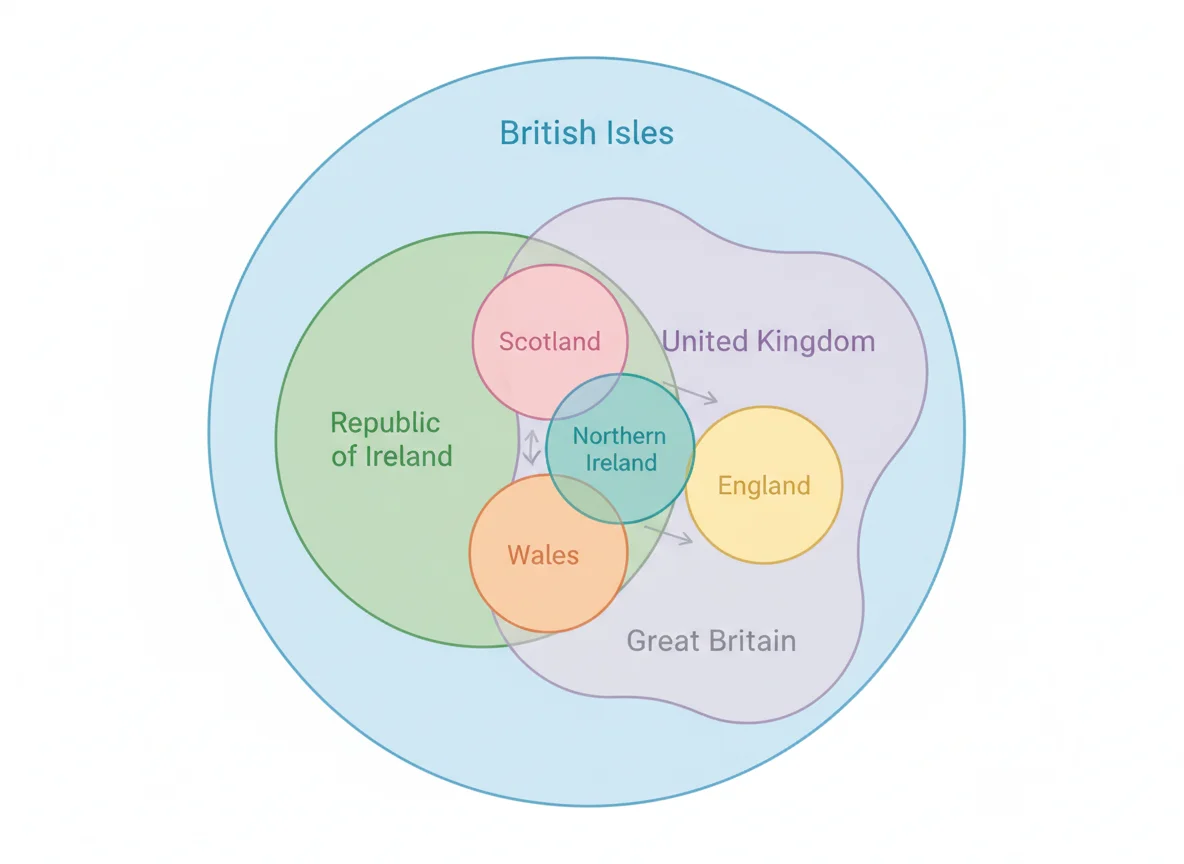
The word 'Britain' is commonly used as a shorthand for the United Kingdom, although technically it refers to Great Britain. People from the UK are often called 'British', and they hold British passports. However, people may also identify specifically as English, Scottish, Welsh, or Northern Irish, reflecting the distinct national identities within the UK.
Key Facts
- 'Britain' is commonly used as shorthand for the UK
- People from the UK are called 'British'
- People may also identify as English, Scottish, Welsh, or Northern Irish
Advertisement